Monday, May 4, 2015

video and image analysis

This music video is a constant crosscut between real life war clips and politicians speaking; to the band themselves acting in war-like scenarios. It's presented with a dirt yellow tint, emphasizing the lack of life and humanity of the world taken over by war. It begins with a satellite image, zooming in more and more down to a single car, the shot is presented as if the viewer is watching through the lense of a rifle, or a drone, watching as the target is being targeted. In one cut-in cut away shot, the lead singer can be seen dressed in full combat gear and points his weapon directly at the camera in full frontilty,  showing the viewer what it feels like to be on the other side of the gun. It then cuts to a medium shot showing the same scene from his side, instantly the intense feeling of being at gun point is no longer over whelming the viewer, displaying the general attitude of apathy towards war in the American society today.  Historical clips like Gandhi's fasting protest are Nazi's walking in uniform are cross cut and played to show contrast between the good and bad ways to push for change in society. As the video progresses, the band can be seen shooting at flying weapons, bombs, and even tanks in a whip pan. No real human opponent can be seen through out the entire video,  suggesting the real enemy is war itself, as well as the pain and destruction it brings; again emphasizing the lack of humanity of war. 
This music video begins with a cross cut between a man's side profile to a boxing ring, the sounds accompanying these cuts are short and cut-off, chaos can be heard during the boxing ring shots, while a loud, steady heart beat muffles the chaos when the shot is cut to the mans side profile. The diegesis here is that his heart is beating hard because he is preparing to fight in the ring. The video then goes back in time, flashback to 6 months ago of the same man washing dishes at a restaurant, the close up shot shows sweat beads dripping down his face, emphasizing his exhaustion, but more plates are brought to him by the owner, ignoring his body conditions completely.   The scene then shows an old man,  who is also the father of the man from the beginning of the video, sitting in a bar alone in a low key lighting shot, he is drinking but his facial expression is sad, suggesting a drinking problem. The scene then crosscuts constantly between the first man experiencing problems in his life; to running in the neighborhood and practicing boxing skills; to Eminem rapping in a dark room with bright backlighting, showing only his silhouette.  One particular scene shows an close up of his father in frontality, screaming at yelling in to the camera, creating extreme discomfort to the viewer. The diegesis here is that he is drunk and yelling at his son for not being able to support the entire family, the scene takes the viewer in the eyes of the man and presents itself to make the viewer feel despair and frustration just as the man feels.  In the scenes where he is running, the shots are filmed with a fish eye lense, creating a sense of entrapment and suffocation, symbolizing his struggle to break free from his current life to better provide for his family. The scenes of Eminem are very low key lighting, his face can't really be seen in that he wants his songs to be focused on the message he is trying to send than on himself. The flashback ends and he is ready to step in to the ring, then his father can be seen drinking at a bar in a cross cut watching his son fight on tv. At the end of the video Chantelle stands in for Sia's voices, standing a rubble of broken down buildings, where she was only presented in a tight, suffocating, low lighting frame before; emphasizing her new found freedom and confidence.
This is a close up shot from the film Shutter Island, the main character Teddy Daniels is being held by his wife, the diegesis here suggests his wife is comforting him, trying to calm him down. Eyes are the windows to one's soul, they convey and express emotions that words can't. Teddy's eyes are completely in shadow, unable to show emotion because the ones he feel are only false emotions. He is blind to the reality just as the audience is, not seeing the truth behind the story where Teddy himself is the one that murdered his family. He is unable to face this fact and therefore blinds himself from the truth, creating another reality for himself to deal with this burden. This shot is relatively well-lit, however, it is dull in color, suggesting a sense of decay and corrosion. 


This is a medium long shot from the TV series Daredevil, it is off centered as well as off balanced, suggesting an imbalance in Wilson Fisk's life. He dominates the right portion of the shot, looking at a plain white painting named Rabbit in a Snowstorm, this painting is a reminder of the darkest times of his childhood. His costume in this shot is a plain black suit, a color of dominance and control, however the painting makes him feel lonely and powerless, a direct contrast between his suit and the white painting. The low key lighting presents the shot with even more contrast, emphasizing the constant battle good vs evil with in the show.

This is a medium close up shot from the TV series Dexter, it shows Dexter as a three year old sitting in a pool of blood. He is looking into the offscreen space at a police officer who then becomes his adopted father. The audiences eyes are drawn to the light on his face as first glance, white and pure although he is surrounded by a pool of dark red blood. Red is a color of violence and evil, while white is a color of innocence and purity. Young Dexter's costume is also white,  however his hands are covered in blood, foreshadowing his fate in the future as a serial killer; his shirt is also blood stained, marking his loss of innocence forever.

Craigslist Joe and The Empathic Civilization

"Selfhood goes together with empathic development, increasing selfhood, increasing empathic development. " (Empathic Civilization)

"We have the technology that allows us to extend the central nervous system and to think viscerally as a family not just intellectually. When that earthquake hit Haiti and then Chile, but especially Haiti, within an hour the Twitters came out and within two hours some cell phone videos, YouTube; and within three hours the entire human race was in a empathic embrace coming to the aid of Haiti." (Empathic Civilization)

"So if you think about the times that we've empathized with each other our fellow creatures it's always because we felt their struggle, we had the depth and empathy and the celebration of live. And we show solidarity with our compassion." -(Empathic Civilization)


During Joe's month long journey, he received help from kind strangers from all across the country, through this kindness, he feels the need to give back and help others himself as well. In one city he organized a toy drive for needy children, as well as volunteering as a tutor. In another he helped a woman with cancer reorganize her living space.

Monday, April 27, 2015

Press pause play

"I wasn't trying to make money, I was trying to make a point." -Seth Robin

"It's not about the leaders and rules. It sounds good and thats what matters." -olafur arnalds

"It's not about better or worse. It's about different."


"Almost everybody I meet in the world of art, music, literature or creative expression, everybody is equally excited and afraid. Nobody really knows where their next pay-check is coming from, but they’re really excited about their ability to create and share their work.." -Moby“

"I personally find perfection in art and music to be really off-putting. I like listening to Billie Holiday because there’s vulnerability […] I get really intimidated and bored by perfect digital art.”- Moby

“We are on the verge of a new dark age. The creative world is destroyed. All we have is cacophony and self opinion. We have a crisis of democratized culture.”- Andrew Keen

Tuesday, April 7, 2015

Smoke Signals


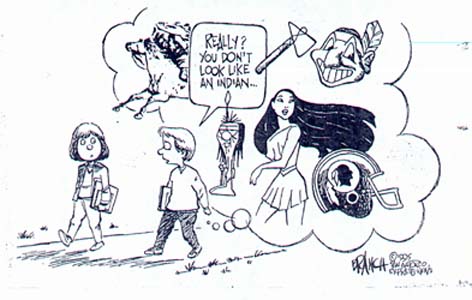
The portrayal of native people by non-native people on the big screen from the beginning of native cinema has always been stereotypical, faulty, and lack authenticity. In the film Smoke Signals by native film maker Chris Eyre, however,this struggle is presented in a comedic light, giving insight to what it's like to be a native person living with the false expectations. During the bus ride where the main characters, Victor and Thomas are on their way to pick up Victor's father's ashes; Victor complains about the amount of times Thomas watches the film Dances With Wolves and how he isn't "indian" enough. "Quit grinning like an idiot. Indians aint supposed to smile like that! Get stoic, like this. You gotta look mean or people won't respect you. White people will run all over you if you don't look mean. You gotta look like a warrior! You gotta look like you just came back from killing a buffalo!" (Smoke Signals)  In which Thomas response to as "But our tribe never hunted buffalo - we were fishermen." (Smoke Signals) The misrepresentation of the Native Nations in cinema creates a false image of what "indians" are suppose to look and act to both native and non-native people, it creates an inaccurate standard and image that native people are expected to lived up to; a mold they're suppose to fit into. Although Thomas enjoys watching Dances With Wolves, he understands the difference between reality and entertainment. When he sees the old western "Indian" film playing at Suzy Song's place, he says "The only thing more pathetic than Indians on TV is Indians watching Indians on TV." (Smoke Signals) Thomas recognizes the ridiculousness of the concept of "Indians" not only being entertainment to white people, but native people as well; it's pathetic that the natives who watch do not even realize the disrespect and racism within those films. For those that do realize and step up to the light to show that the Native Nations aren't what all the movies have made them out to be, it's rough journey. After having to put up with the sheriff's racist indian jokes, Thomas and Victor were able to not be leave his office without charges. " 'I can't believe we got outta that guy's office alive.'  'Yeah, I guess your warrior look does work sometimes.' " (Smoke Signals) The real sad thing here is that although the accident was completely the drunken white man's fault, no one would have believed Thomas and Victor's words if it weren't for the man's wife speaking out against her husband. They joke about living up to the "warrior Indian" image, but they knew when it really came down to White vs Native, Native doesn't stand a chance. There are many more ironic remarks made by native people through out the film that mock the native stereotype established by the film industry, whether intentional or not, they're bringing awareness and shining a positive light on native films.


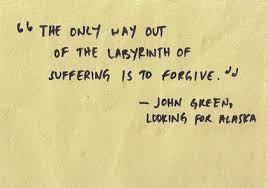
As Victor's character develops throughout the film, a theme of forgiveness emerges. Through Victor's journey to retrieve his father's ashes, he learns to forgive not only his father, but also himself.  From the beginning of the film, Thomas can be seen tossed out of a window and saved by Victor's father Arnold. " 'You saved Thomas. You did a good thing.' 'I didn't mean to.'" (Smoke Signals) Tomas's Grandma thanks Arnold for saving Thomas, even though she knew the fire was Arnold's fault, she still is thankful for having her grandson, and she want to remind Arnold there's still a sliver lining in the tragedy. However Arnold spent the rest of his days drowning in the guilt and responsibility, never being able to forgive himself, which led to his abusive acts toward Victor, alcoholism and eventually
leaving his family behind. Unfortunately, Victor never knew about the reason behind his father's action till it was too late. In an argument Thomas has with Victor, the subject of Arnold leaving comes up and Thomas points out how it has changed Victor. "All I know is that when your father left, your mother lost you too." (Smoke Signals) When Arnold left, Victor was only a child; he didn't know why his father left, so naturally, he blamed himself. He was so focused on the hurt his father brought to him, he couldn't see the hurt he brought to his mom. Once Victor found out the real reason why Arnold left and why he'd always been more of a father to Thomas that himself, he is finally able to let go of his painful past. Although Arnold passed before he was able returned home to his wife and son, Victor is the one to release his ashes back in to the cycle of life, and Thomas's voice ends the film with "Do we forgive our fathers in our age or in theirs? Or in their deaths, saying it to them, or not saying it?If we forgive our fathers what is left?" (Smoke Signals) Victor forgives in both Arnold's time and his time, he is able to forgive his father for leaving when he found out about the fire. he then able to forgive himself. He can finally forgive and forget, let go of his past of pointing blame and taking blame, and move on with his life, with only the great memories of his father.


Monday, March 16, 2015

Writing Post #22 Ceremony analysis

Through Tayo's journey of looking for the spotted cattle and bringing it home, he also experiences self-discovery, becoming more aware and understanding of his emotions and presentness. T'seh serves similar purpose as Reed Woman, a symbol of life; when she sleeps with Tayo, she aids in his process of healing, literally bringing the life back to his life in which helps him be more perceptive of the world around him. "He breathed deeply, and each breath had a distinct smell of snow from the north, of ponderosa pine on the rimrock above; finally he smelled horses from the direction of the corral, and he smiled. Being alive was alright then, he had not breathed like for a long time." (Silko 181). This detailed description is the first time Tayo's sense of smell has be presented in a rather positive light, instead of those filled with damp, rotting memories of war.

Thursday, February 19, 2015

Reel Injun

 v.s 
Film has always been a reflection of society at the time, it mirrors and guides the beliefs, values, and views of the audience, documenting the history of humanity as it evolves. When done inaccurately, it is powerful enough to blindly stereotype and depict false images of people and cultures as a whole. Something Native Americans are far too familiar with: their authenticity overshadowed and defined by the "white hollywood" cinema culture. A culture of native fetish emerged when Buffalo Chance Long Lance became the ultimate Indian warrior in the public eye for the film The Silent Enemy, it was a drastic change of representation of the the native people in the film industry, they were played by actual natives and seen for more than just savages. What the public didn't know, was that Buffalo Child Long Lance came from a tri-racial background: Indian, Black, and White. Melinda Micco said, "He would show up, his hair slicked back, dark skin, in this beautiful tuxedo; and everybody's looking for the Indian to appear." (Reel Injun) People were so obsessed with the Indian image that they couldn't see Long Lance for the person he really is, they could not see him beyond the character of a mystic warrior dressed in animal skin saving his people; once he showed up in a suit instead of native clothing, it broke people's fantasy of the iconic Indian hero. They couldn't comprehend that he was a normal human being, just like the rest of them. Native culture is different, it was mythical, and this unfamiliarity is what fuels the fantasies about native people; who they are v.s. who they suppose to be. Jesse Wente described, "I was lucky enough to grow up in a time where native people were the cool thing to be, and I would remember going to parties where white people would come to me and wanna touch my hair and describe themselves getting and Indian name from an elder at some ceremony somewhere."(Reel Injun) The native fetish extends from just movies to every aspect of native life, what they wear, what they look like, and their culture. Which sounds like a good thing, except rather than being educated about the culture the White population so "interested" in, they simply only mimic what is presented on the surface by films without any deeper understanding or connection. Thereby taking away from the authenticity of the culture itself, discrediting it's social and historic significance and treating as as some sort of hobby or trend. In some places, this trend has become a favorite pass time for children: "native" summer camps to teach boys to get in touch with nature and educate them about the native culture. One of the camp leader summarized his knowledge of the native culture as, "Through these movies I think I pretty much got the whole mentality of the native."(Reel Injun) This is incridubily disrespectful and ironic in that that is the mentailty of the greater population of believing what the films portray is what the reality is, that a whole culture can
be understood and connect through a couple of movies. The whole idea of the camp is intended to educate and honor the native culture with the young generation, but because of the lack of real understanding of the culture, it's only teaching a false stereotypes and ignorance. It really isn't a native camp at all, just a group of ignorant people using native culture to justify their acts of savagery and violence. The problem with the native fetish is that although it often begins with good intentions of outsiders getting to know a different culture, it always results in the ignorance that people think they understand it based off of one perspective and they believe that that's all there is to that culture.


Since the beginning of films, native people have been portrayed through many different lenses, whether it's the savage Indian, the groovy Indian, the mean Indian, or the cool Indian. They all had one thing in common, they were all told in the idea of portray the Indian, overlooking the realness of these people. In the film Flags of Our Fathers, actor Adam Beach played a young solider turning to alcohol to face his fears of leaving his family behind to go to war, his character finally puts a face on the stereotype of a drunken Indian.  Adam Beach himself described his character as, "shredding human emotion, no stereotypes, no Indians, just a young boy that wants to see his mom."(Reel Injun) This film finally shined light to address issues that exist in every group of people rather than just Indians.  It recognizes the humanity life, that everyone is human with raw human emotions, and that the young boy drank because that's how people deal with the pain of being separated from his family in order to fight for his country, not because he was Indian.  In 2001, a film called Atarjuat, otherwise known as The Fast Runner was released. It tells the tales of an ancient story passed down in the native tribe generation by generation, captured and documented with film, preserving the vanishing culture. What set's this film apart from the previous native films is that it's the first film to tell a story from the native perspective, not trying to prove anything to the rest of the world. Zachary Kunak said, "It's just culture, storytelling in it's purest form possible, capturing human experience in the rawest way."(Reel Injun) As a film maker, his intention was only to document a story passed down fro the grandparents of grandparents that's never been written down, to hold on to the stories that shaped the native culture. It tells the story without stereotypes, stripped of fancy plots and native "hype", not trying to present an argument. His targeted audience isn't particularly white people or native people, but people as a whole; everyone has stories that molded their culture,  stories that give insight to who they are as human beings, Zachary simply told his through cinema. When dealing with unfamiliar things, people often are quick to jump to conclusions, putting a label on things they may or may or understand yet; that is exactly what happened with the native culture, jumping from one label to another. Fortunately, it's a time of change and real understanding, people are finding their voices to help the rest of the world understand better. Chris Eyre said," We're not asking to be noble, good, or righteous all the time. We're only asking to be human."(Reel Injun) Real, authentic native films are finally emerging, presenting to the rest of the world that they are only human, that just like everyone else, there's always the good, the bad and the evil. There is just no way of grouping an entire culture as a single label without misrepresentation and reducing the culture as a whole. It finally speaks out that native people are in fact, real people with real and raw human emotions. After 4000 films representing native people, there's finally progress being made. Native people are no longer only being misrepresented as one thing alone, they are seen as human beings, not a savage, not a warrior, especially not some sort of mythical creature, they are just human.