Monday, April 27, 2015

Press pause play

"I wasn't trying to make money, I was trying to make a point." -Seth Robin

"It's not about the leaders and rules. It sounds good and thats what matters." -olafur arnalds

"It's not about better or worse. It's about different."


"Almost everybody I meet in the world of art, music, literature or creative expression, everybody is equally excited and afraid. Nobody really knows where their next pay-check is coming from, but they’re really excited about their ability to create and share their work.." -Moby“

"I personally find perfection in art and music to be really off-putting. I like listening to Billie Holiday because there’s vulnerability […] I get really intimidated and bored by perfect digital art.”- Moby

“We are on the verge of a new dark age. The creative world is destroyed. All we have is cacophony and self opinion. We have a crisis of democratized culture.”- Andrew Keen

Tuesday, April 7, 2015

Smoke Signals


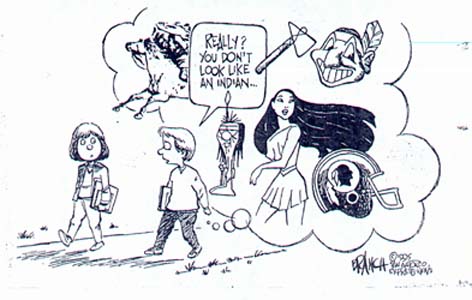
The portrayal of native people by non-native people on the big screen from the beginning of native cinema has always been stereotypical, faulty, and lack authenticity. In the film Smoke Signals by native film maker Chris Eyre, however,this struggle is presented in a comedic light, giving insight to what it's like to be a native person living with the false expectations. During the bus ride where the main characters, Victor and Thomas are on their way to pick up Victor's father's ashes; Victor complains about the amount of times Thomas watches the film Dances With Wolves and how he isn't "indian" enough. "Quit grinning like an idiot. Indians aint supposed to smile like that! Get stoic, like this. You gotta look mean or people won't respect you. White people will run all over you if you don't look mean. You gotta look like a warrior! You gotta look like you just came back from killing a buffalo!" (Smoke Signals)  In which Thomas response to as "But our tribe never hunted buffalo - we were fishermen." (Smoke Signals) The misrepresentation of the Native Nations in cinema creates a false image of what "indians" are suppose to look and act to both native and non-native people, it creates an inaccurate standard and image that native people are expected to lived up to; a mold they're suppose to fit into. Although Thomas enjoys watching Dances With Wolves, he understands the difference between reality and entertainment. When he sees the old western "Indian" film playing at Suzy Song's place, he says "The only thing more pathetic than Indians on TV is Indians watching Indians on TV." (Smoke Signals) Thomas recognizes the ridiculousness of the concept of "Indians" not only being entertainment to white people, but native people as well; it's pathetic that the natives who watch do not even realize the disrespect and racism within those films. For those that do realize and step up to the light to show that the Native Nations aren't what all the movies have made them out to be, it's rough journey. After having to put up with the sheriff's racist indian jokes, Thomas and Victor were able to not be leave his office without charges. " 'I can't believe we got outta that guy's office alive.'  'Yeah, I guess your warrior look does work sometimes.' " (Smoke Signals) The real sad thing here is that although the accident was completely the drunken white man's fault, no one would have believed Thomas and Victor's words if it weren't for the man's wife speaking out against her husband. They joke about living up to the "warrior Indian" image, but they knew when it really came down to White vs Native, Native doesn't stand a chance. There are many more ironic remarks made by native people through out the film that mock the native stereotype established by the film industry, whether intentional or not, they're bringing awareness and shining a positive light on native films.


As Victor's character develops throughout the film, a theme of forgiveness emerges. Through Victor's journey to retrieve his father's ashes, he learns to forgive not only his father, but also himself.  From the beginning of the film, Thomas can be seen tossed out of a window and saved by Victor's father Arnold. " 'You saved Thomas. You did a good thing.' 'I didn't mean to.'" (Smoke Signals) Tomas's Grandma thanks Arnold for saving Thomas, even though she knew the fire was Arnold's fault, she still is thankful for having her grandson, and she want to remind Arnold there's still a sliver lining in the tragedy. However Arnold spent the rest of his days drowning in the guilt and responsibility, never being able to forgive himself, which led to his abusive acts toward Victor, alcoholism and eventually
leaving his family behind. Unfortunately, Victor never knew about the reason behind his father's action till it was too late. In an argument Thomas has with Victor, the subject of Arnold leaving comes up and Thomas points out how it has changed Victor. "All I know is that when your father left, your mother lost you too." (Smoke Signals) When Arnold left, Victor was only a child; he didn't know why his father left, so naturally, he blamed himself. He was so focused on the hurt his father brought to him, he couldn't see the hurt he brought to his mom. Once Victor found out the real reason why Arnold left and why he'd always been more of a father to Thomas that himself, he is finally able to let go of his painful past. Although Arnold passed before he was able returned home to his wife and son, Victor is the one to release his ashes back in to the cycle of life, and Thomas's voice ends the film with "Do we forgive our fathers in our age or in theirs? Or in their deaths, saying it to them, or not saying it?If we forgive our fathers what is left?" (Smoke Signals) Victor forgives in both Arnold's time and his time, he is able to forgive his father for leaving when he found out about the fire. he then able to forgive himself. He can finally forgive and forget, let go of his past of pointing blame and taking blame, and move on with his life, with only the great memories of his father.


Monday, March 16, 2015

Writing Post #22 Ceremony analysis

Through Tayo's journey of looking for the spotted cattle and bringing it home, he also experiences self-discovery, becoming more aware and understanding of his emotions and presentness. T'seh serves similar purpose as Reed Woman, a symbol of life; when she sleeps with Tayo, she aids in his process of healing, literally bringing the life back to his life in which helps him be more perceptive of the world around him. "He breathed deeply, and each breath had a distinct smell of snow from the north, of ponderosa pine on the rimrock above; finally he smelled horses from the direction of the corral, and he smiled. Being alive was alright then, he had not breathed like for a long time." (Silko 181). This detailed description is the first time Tayo's sense of smell has be presented in a rather positive light, instead of those filled with damp, rotting memories of war.

Thursday, February 19, 2015

Reel Injun

 v.s 
Film has always been a reflection of society at the time, it mirrors and guides the beliefs, values, and views of the audience, documenting the history of humanity as it evolves. When done inaccurately, it is powerful enough to blindly stereotype and depict false images of people and cultures as a whole. Something Native Americans are far too familiar with: their authenticity overshadowed and defined by the "white hollywood" cinema culture. A culture of native fetish emerged when Buffalo Chance Long Lance became the ultimate Indian warrior in the public eye for the film The Silent Enemy, it was a drastic change of representation of the the native people in the film industry, they were played by actual natives and seen for more than just savages. What the public didn't know, was that Buffalo Child Long Lance came from a tri-racial background: Indian, Black, and White. Melinda Micco said, "He would show up, his hair slicked back, dark skin, in this beautiful tuxedo; and everybody's looking for the Indian to appear." (Reel Injun) People were so obsessed with the Indian image that they couldn't see Long Lance for the person he really is, they could not see him beyond the character of a mystic warrior dressed in animal skin saving his people; once he showed up in a suit instead of native clothing, it broke people's fantasy of the iconic Indian hero. They couldn't comprehend that he was a normal human being, just like the rest of them. Native culture is different, it was mythical, and this unfamiliarity is what fuels the fantasies about native people; who they are v.s. who they suppose to be. Jesse Wente described, "I was lucky enough to grow up in a time where native people were the cool thing to be, and I would remember going to parties where white people would come to me and wanna touch my hair and describe themselves getting and Indian name from an elder at some ceremony somewhere."(Reel Injun) The native fetish extends from just movies to every aspect of native life, what they wear, what they look like, and their culture. Which sounds like a good thing, except rather than being educated about the culture the White population so "interested" in, they simply only mimic what is presented on the surface by films without any deeper understanding or connection. Thereby taking away from the authenticity of the culture itself, discrediting it's social and historic significance and treating as as some sort of hobby or trend. In some places, this trend has become a favorite pass time for children: "native" summer camps to teach boys to get in touch with nature and educate them about the native culture. One of the camp leader summarized his knowledge of the native culture as, "Through these movies I think I pretty much got the whole mentality of the native."(Reel Injun) This is incridubily disrespectful and ironic in that that is the mentailty of the greater population of believing what the films portray is what the reality is, that a whole culture can
be understood and connect through a couple of movies. The whole idea of the camp is intended to educate and honor the native culture with the young generation, but because of the lack of real understanding of the culture, it's only teaching a false stereotypes and ignorance. It really isn't a native camp at all, just a group of ignorant people using native culture to justify their acts of savagery and violence. The problem with the native fetish is that although it often begins with good intentions of outsiders getting to know a different culture, it always results in the ignorance that people think they understand it based off of one perspective and they believe that that's all there is to that culture.


Since the beginning of films, native people have been portrayed through many different lenses, whether it's the savage Indian, the groovy Indian, the mean Indian, or the cool Indian. They all had one thing in common, they were all told in the idea of portray the Indian, overlooking the realness of these people. In the film Flags of Our Fathers, actor Adam Beach played a young solider turning to alcohol to face his fears of leaving his family behind to go to war, his character finally puts a face on the stereotype of a drunken Indian.  Adam Beach himself described his character as, "shredding human emotion, no stereotypes, no Indians, just a young boy that wants to see his mom."(Reel Injun) This film finally shined light to address issues that exist in every group of people rather than just Indians.  It recognizes the humanity life, that everyone is human with raw human emotions, and that the young boy drank because that's how people deal with the pain of being separated from his family in order to fight for his country, not because he was Indian.  In 2001, a film called Atarjuat, otherwise known as The Fast Runner was released. It tells the tales of an ancient story passed down in the native tribe generation by generation, captured and documented with film, preserving the vanishing culture. What set's this film apart from the previous native films is that it's the first film to tell a story from the native perspective, not trying to prove anything to the rest of the world. Zachary Kunak said, "It's just culture, storytelling in it's purest form possible, capturing human experience in the rawest way."(Reel Injun) As a film maker, his intention was only to document a story passed down fro the grandparents of grandparents that's never been written down, to hold on to the stories that shaped the native culture. It tells the story without stereotypes, stripped of fancy plots and native "hype", not trying to present an argument. His targeted audience isn't particularly white people or native people, but people as a whole; everyone has stories that molded their culture,  stories that give insight to who they are as human beings, Zachary simply told his through cinema. When dealing with unfamiliar things, people often are quick to jump to conclusions, putting a label on things they may or may or understand yet; that is exactly what happened with the native culture, jumping from one label to another. Fortunately, it's a time of change and real understanding, people are finding their voices to help the rest of the world understand better. Chris Eyre said," We're not asking to be noble, good, or righteous all the time. We're only asking to be human."(Reel Injun) Real, authentic native films are finally emerging, presenting to the rest of the world that they are only human, that just like everyone else, there's always the good, the bad and the evil. There is just no way of grouping an entire culture as a single label without misrepresentation and reducing the culture as a whole. It finally speaks out that native people are in fact, real people with real and raw human emotions. After 4000 films representing native people, there's finally progress being made. Native people are no longer only being misrepresented as one thing alone, they are seen as human beings, not a savage, not a warrior, especially not some sort of mythical creature, they are just human.


Monday, January 19, 2015

Dances with Wolves analysis


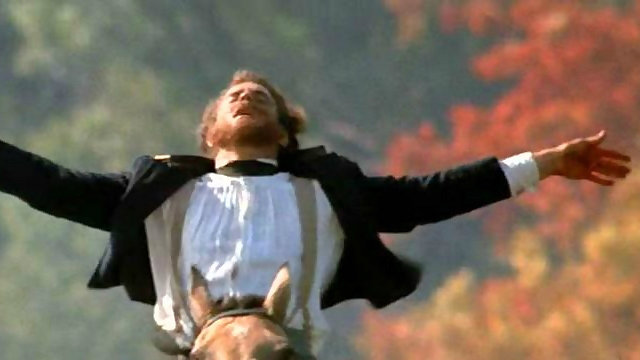
Dances with Wolves is an 1990 filmed directer Kevin Costner, also the main character in the film as Lt. Dunbar. This film masters the use of pathos to appeal to human emotion through music techniques, as well as varies shots and angles to convey feeling to the audience. In the beginning of the film during a battle in the Civil War at stalemate, Dunbar rides out in the middle of the battle field with his hands out in a Christ pose and this action turned the tide and helped them win that battle. This scene is accompanied by muffled sounds of cheers, gun shots, and background music of triumph, in muffling the sounds, it creates a enlightened effect in relation to Dunbar's Christ pose to emphasize his state of mind of loyalty and sacrifice to his army. The sounds then fade back into a chaotic mix of gunshots and yelling, pulling the audience back to reality from Dunbar's "peaceful" mind. This creates a drastic contrast between the reality of war and the romanticized version of war and glorification of sacrifice. Dunbar chooses his reward and recognition for this sacrifice to go out on the frontiers and see the plains, in which he meets Major Famsbrough, who has intense PTSD. During the scene as Famsbrough opens and closes his drawers, theres sound of alcohol bottles rattling around, suggesting the severity of his PTSD in developing a drinking problem as a way to self medicate and cope. Obviously, it was an ineffective way because at the end of the scene, he takes a drink and shoots himself; in which Dunbar hears the gunshot but has no idea what happened, totally unaware of what's waiting for him ahead.


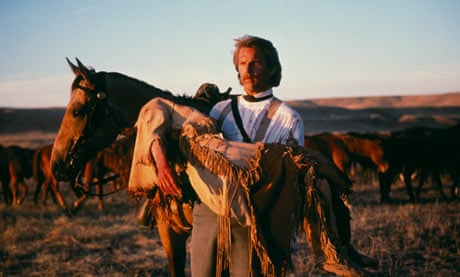
Through a long and exhausting  journey, Dunbar finally arrives at hispost with a peasant name Timmons; it's a place of new beginnings and discoveries for Dunbar, but unfortunately, it's where Timmons meets his end. When Dunbar's smoke summoned a group of the Pawnee nation, one of the Pawnee's saw Timmons and shot&scalped him. This scene is particularly heartbreaking because of the low pitch sound of despair as Timmons tried to crawl away but just got shot by arrow more; and as he breathing his last breathes, he did not beg for his life but rather the safety of his mules. This demonstrated the cruelty of the Pawnee member and the miscommunication between the two sides where the Pawnee thought of Timmons as a white settler but really he's just trying to get home.  Another native nation comes into the picture when Dunbar is bathing and washing in the pond and Kicking Bird from the Sioux Nation comes to his post looking around and attempting to take his horse. In this scene Dunbar is completely naked, suggesting his vulnerability of being alone and open to the unknown; but it does not stop him from confronting Kicking Bird to protect his horse, the one thing that keeps him company and sane in a time of absolute loneliness.   After his encounters with the Sioux Nation, he decides it's time to stop waiting around and take action to find "indians." On his way he encounters a Caucasian woman dressed in native clothing, cutting her wrist and bleeding out; he helps wrap her wounds with strips of the American flag and carries her with him as he find the Sioux Nation. This scene is shot as the cliche hero saves the beauty story, the shot focuses  on Dunbar carrying the woman and overlooking the plains with the sunlight leaking through, it's a romanticized shot of him stepping into the unknown and pulling away from the American society he is use to.


Friday, November 21, 2014

Matthew Shepard: hate crime?

             A hate crime is a violent act of crime motivated by racial, sexual, or other prejudice. The death of 21 year old Matthew Shepard in 1998 caused an outrage in both gay and straight communities all across the world, and whether his death was the result of a hate crime or not, that is debatable.  Many factors uncounted for and undetected by the public media at the time of the incident play a major part in his passing that would categorize Shepard's death as a drug related murder rather than a hate crime, but having his death viewed as a hate crime has positively influenced many people  globally and he became a voice for the gay community and speak out to take a stand for all the hate that does does exist based on sexuality. 
            The role of public media in the case of Matthew Shepard outweighs any other factors in that the case blew up overnight grabbing the attentions of people globally. Before any real investigation efforts were put into Shepard's case, the media jumped in and labeled the case as a hate crime, reporting on live TV on the hatred that exists within the Town of Laramie based on the mere fact that Shepard was gay. "Within 36 hours there were satellite trucks in Laramie." (20/20 ABC). Media responded to Shepard's case immediately, every news station and reporter wanted to be the first to report any updates and have the "first hand" and "exclusive" information on the case.  Soon enough the whole world was watching Laramie, following up on anything that happened, their interference and the attention it brought upon Shepard's family and friends was tremendous. "Shepard's father had to wear a bullet proof vest to speak at his own son's funeral" (20/20 ABC). Because of the media attention, Shepard's funeral became a live stream on TV, the case had not only captured the eyes of those who are mournful, but also those who believed Shepard deserved to die because of his sexuality and couldn't let Shepard's loved ones mourn in peace and the family felt threatened enough to take precautions to protect their own lives.  They are a group from the Westboro Baptist Church, claiming under God's name to justify their acts of hate and extremely offensive actions against the gay community. "They are a group of hateful people with signs and a lot time on their hands, they stood outside chanting and holding up "God hates f**s"" (Huffingtonpost). It was horrifying enough 
that Shepard's death might have been because of his sexuality, however the Westboro Baptist Church still felt the need to cause public disturbances and hold signs that say Shepard deserved was he got. It's unacceptable, hate crime or not, Shepard deserved to be buried at peace and mourned by his loved ones without the entire world watching and people cursing at his name. 
                Long after Shepard's death and the outrage of the hate behind the incident did people finally stop to ask, was it really a hate crime? At the time of the incident, McKinny openly admitted and confessed he killed Shepard because he was gay and made a pass at McKinny. "I was like, "Look I'm not a fu**ing fa**ot. If you touch me again you're gonna get it." I  don't know what the hell he was trying to do  but I beat him up pretty good, I think I killed him." (Kaufman 25). Instead of confessing to robbery or drug related issues, McKinny admitted to the case standing behind the "Gay Panic" defense in hopes of a valid excuse to get a lighter sentence. However he did not expect for the case to create an outrage and uproar landing him in two life sentences. In 2004,  McKinny and Henderson, spoke to press for the first time since the incident and it brought a whole new perspective into the case and overturns the crime all together. "Arron used drugs everyday..did not sleep for a week....Matt wanted a ride/sex and Arron wanted to rob him.." (Price 20/20 ABC). The role of meth in this case was brought to attention for the first time, revealing McKinny had been a awake for a whole week prior to the night of the incident and he meant to rob a drug dealer of 10,000 dollars but failed so he turned his eyes on Shepard when Shepard asked for a ride.Shepard's involvement with meth went unmentioned as he was the poster boy for the gay community, as did the fact that he was HIV positive due to a trip to Morocco where he was raped by two men when he was younger, which is a factor that drove him to meth to self medicate.  Another  important factor that was over looked at the time of trial was that McKinny, Henderson, and Shepard were friends; they hung out together, partied together, it was not as simple as gay panic against a stranger who asked for a ride. "well..it was me, Arron, and Matt." (O'Connor 20/20 Special). Doc O'Connor, a limo driver that often drove Shepard to gay bars in Denver mentioned McKinny and Shepard were definitely friends, and that McKinny was bisexual; he also openly admitted to having threesomes with them, which completely contradicts the whole gay panic defense. The media at the time went out of their way to try and prove the Shepard case was hate crime, even paying friends of McKinny to say things that play in favor of the labeling of a hate crime, knowing that will bring more attention to the case that just a simple meth related murder and the victim just happened to be gay.   
              Hate crime or not, the positive influence Shepard's case had brought to help the gay community speak out and laws to protect crimes that are truly targeted toward people based on their sexuality. One of the major laws is the Matthew Shepard and James Byrd. Jr Hate Crime Prevention Act signed by President Obama on October 22, 2009. "After more than a decade of opposition and delay, we've passed inclusive hate crimes legislation to help protect our citizens from violence based on what they look like, who they love, how they pray, or who they are." (Obama). Even though it took 12 years for the law to be passed, it wouldn't have happened if it weren't for wrongful attention upon Shepard's case that led to the attention to the oppressed population of the gay community. Many people argue that the case is only a big deal because Shepard was gay, and that it wouldn't have been such a sensation if he was straight in defense that one's life, or rather death, should not be valued more than another based on sexuality. "We wouldn't be here if this was just another murder the state was going to deal with. The state deals with hundreds of murders every single day. But this murder is different, because the f**s are bringing us out here trying to make Matthew Shepard into a poster boy for the gay lifestyle. And we're going to answer it, its just that simple." (Kaufman 76). Reverend Fred Phelps says this in defense for the push back on the Shepard case and the gay life style, however, in his defense he reveals an underlying issue that because the gay community is so oppressed that the death of a member is such a big deal; the the gay community had equal rights in the first place, it would have just been another murder. After Shepard's death, Shepard's mother and father, Judy and Dennis Shepard,  founded the Matthew Shepard Foundation in his name to "Created to honor Matthew in a manner that was appropriate to his dreams, beliefs, and aspirations, the Foundation seeks to “Replace Hate with Understanding, Compassion, & Acceptance” through its varied educational, outreach and, advocacy programs and by continuing to tell Matthew’s story." (matthewshepard.org).  The Matthew Shepard Foundation works with the Department of Justice and FBI on educational programs to spread awareness, replacing hate with understanding, compassion, and support; to reach out globally encouraging respect for human dignity and differences.  His death, no matter the motivation, has changed the way in which the world talks and deals about hate.
          In away, any crime could be classified as a hate crime, it is hatred towards something or someone that drives one to take another's life. However, although in no way Shepard's death can be distinctively justified as a hate crime or drug related, his death can be viewed as a sacrifice that changed the society for the better, bringing attention to issues that went unspoken and oppressed, freeing people from prejudice with open minds and open hearts, all across the globe.